
Environment
Himachal to Adopt ‘Borehole Resin Extraction’ Method to Minimize Damage to Pine Trees & Maximize Quality

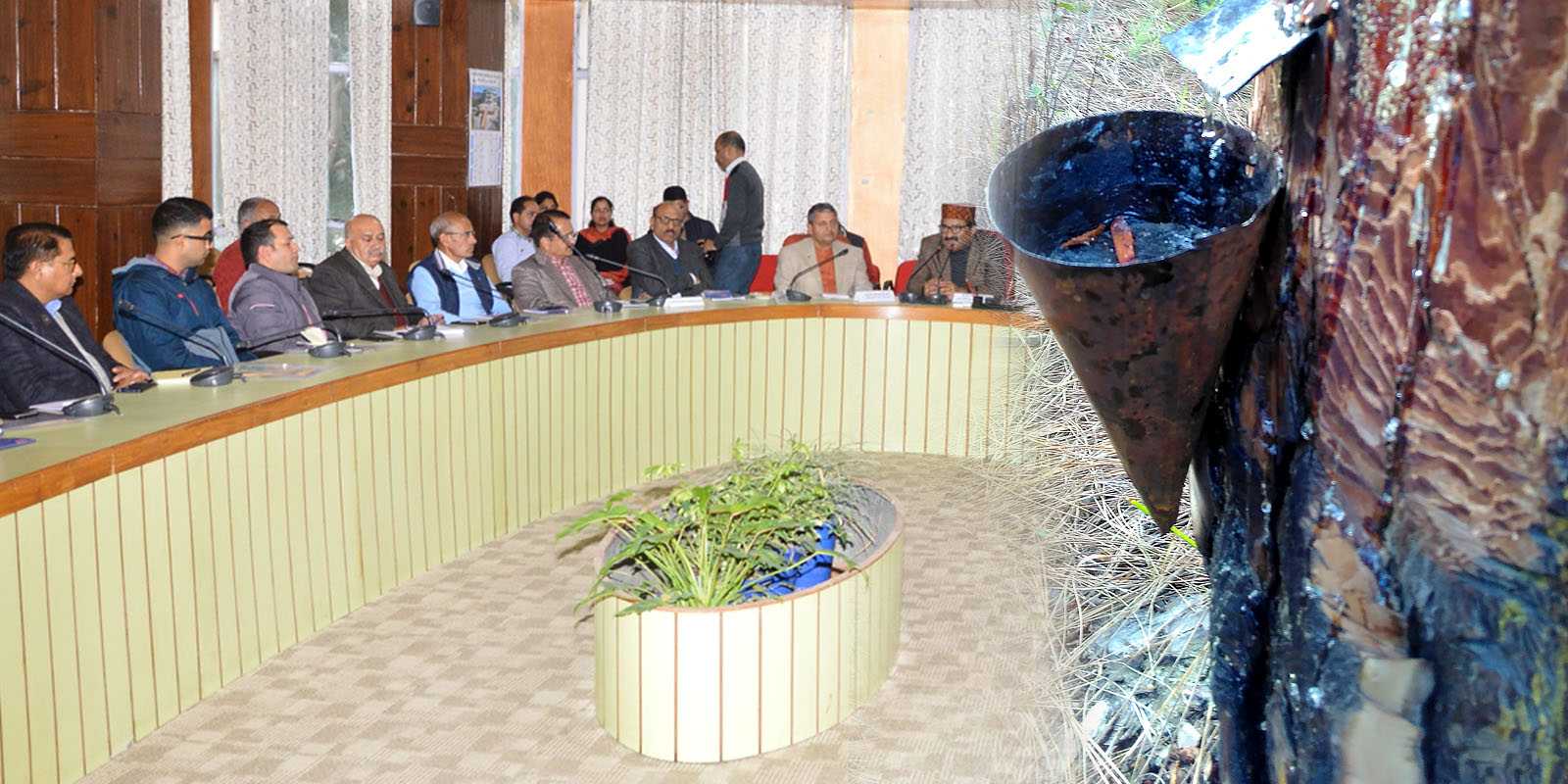
Solan-In the past decade, intensive resin tapping by rill method has resulted in the drying of thousands of pine trees in Himachal Pradesh. It has also been observed, that the application of higher concentration of acid, used as a freshener, had adversely affected the growth of trees and even the tapped surface area is not healing.
Therefore, the HP State Forest Development Corporation will soon adopt the borehole technique of oleoresin extraction to minimize the damage caused to pine trees by resin tapping and simultaneously increase the quality of the collected resin.
It was informed by Himachal Pradesh Forest Minister Sh. Gobind Singh Thakur during the concluding session of the one-day training of officials from HP State Forest Development Corporation at the Dr YS Parmar University of Horticulture and Forestry (UHF) Nauni. The method has been developed by the scientists of the Forest Products Department of the university.
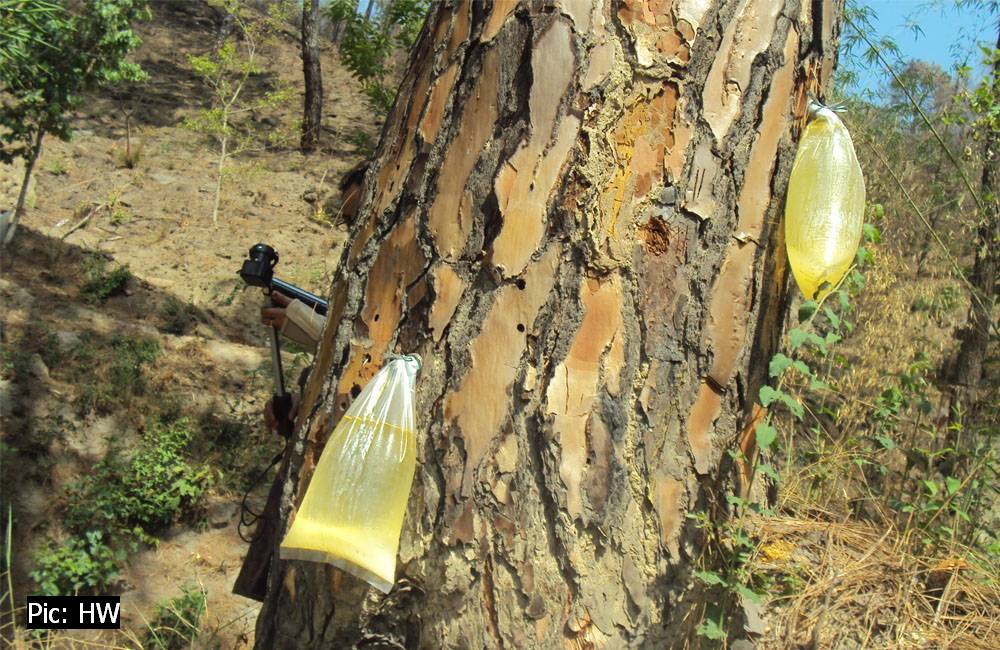
Borehole Resin Extraction’ Method
The Forest Minister said that the department would adopt the new technique in the coming time so that the twin motives of resin quality and its quantity along with ensuring the good health of the trees can be met. He said that the Forest Department will work in collaboration with the university so that the benefit of the various technologies developed by it can be put to the best use for the development of the state.
BD Suyal, MD State Forest Corporation said that technique is quite encouraging and the corporation will take up setting up 10-15,000 bores in every directorate to assess the results of the method. He added that in the second phase the contractors and the labourers will be also be trained on technique by the university. Earlier, Dr Kulwant Rai Sharma gave a detailed presentation and practical demonstration on the technique to the forest officials. He said that the adoption of the technology can prove to be boon for the forests and the resin industry.
What is Borehole Method of Resin Extraction
The new method involves drilling small holes (1 inch wide and 4 inches deep) with the help of simple tools into the tree to open its resin ducts. The holes are drilled with a slight slope towards the opening, so that oleoresin drains freely. Multiple boreholes are arrayed evenly around the tree’s circumference, or clustered in groups of two or three. Spouts are tightly fitted into the opening with polythene bags attached to it with the help of tie for resin collection.
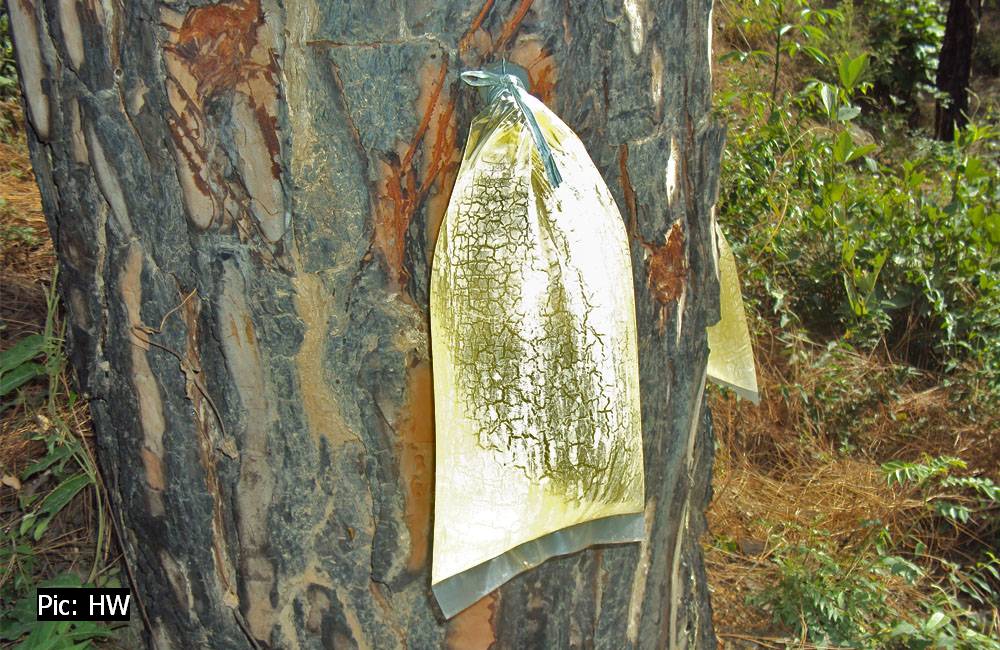
Borehole Resin Extraction’ Method
The new technique was developed in an attempt to overcome some of the limitations of other conventional methods. A key feature of the method is that a closed collection apparatus prevents premature solidification of resin acids, thereby maintaining oleoresin flow for an extended period of up to six months. Due to reduced oxidation and contamination, the end product is of higher quality with substantially higher turpentine. The average yield per tree is almost the same if numbers of boreholes on a tree are adjusted as per the maximum carrying capacity of the tree. The method also allows tapping of lower diameter trees depending upon their potential of production without having any impact on their health. The crown fire hazards incidents are also less because there is no hard resin accumulation on the main stem and spread of ground blaze can be easily avoided by removing the bags well in time.
The rosin and turpentine oil obtained from borehole method are of very good quality, which can fetch higher prices in the market. In addition to tackling the problems of tree health, labour requirements and costs for borehole tapping are significantly lower than conventional methods. The borehole wounds cause little damage to the tree bark and since these holes are near the ground level, only a healed scar can be seen in the converted woods. Therefore, there is no damage to the merchantable part of the tree.
Further, the Forest Minister also said that the university and the forest department will look to work together for establishing an eco-tourism model on the university campus. He added that the University Vice-Chancellor will be invited to all the important policy meetings of the state forest department to seek their expertise. The forest minister visited the demonstration block of borehole technique and also planted a tree at the university.
UHF Vice-Chancellor Dr Parvinder Kaushal called for continuous interaction between the university and the forest department. He emphasized on apprising the grass root level workers and train them on the new technique.
The event was attended by BD Suyal, Managing Director, HP Forest Corporation; KK Kataik Director(South); Dr JN Sharma, Director Research, Dr Kulwant Rai Dean College of Forestry and other officials of the university. Around 30 officers of the rank of Divisional Managers and Assistant Managers from various parts of the state took part in the training.





Environment
Shimla: Retaining Wall Collapses During Four-Lane Construction, Residents Flee Homes to Save Lives


SHIMLA | 3 July 2025 –A major mishap occurred in the Lindi Dhar village of Shimla district during the ongoing four-lane highway construction, raising fresh concerns over safety and construction quality. A retaining wall, constructed as part of the project, collapsed once again—posing a serious threat to nearby homes and destroying hundreds of apple trees.
According to local residents, this is not the first time the wall has caved in. Despite previous incidents, authorities failed to take adequate corrective measures. The latest collapse forced several families to abandon their homes for safety, fearing further landslides and structural damage.
Villagers have accused the National Highways Authority of India (NHAI) and its contractors of negligence. They allege that no proper safety precautions were taken in the construction process, even though the area is known to be vulnerable to landslides.
“This wall had collapsed earlier too, but no permanent solution was provided. Now, we are facing the same threat again. Our lives and properties are at constant risk,” said a local resident.
The landslide also damaged a large number of apple orchards—adding to the losses of local farmers who depend on horticulture for their livelihood.
Residents have demanded immediate intervention from the administration and strict action against those responsible for the substandard construction. They have also urged NHAI to put in place robust safety measures to prevent such incidents in the future.
Local officials have visited the site, and further assessment is awaited.
Environment
Police Complaint Alleges Criminal Negligence in Four-Lane Highway Project Between Parwanoo and Solan

Solan | 30 June 2025 – A police complaint has been filed at the Parwanoo Police Station in Solan district, alleging criminal negligence and environmental damage in the construction of the four-lane highway between Parwanoo and Solan. The complaint, submitted by former Deputy Mayor of Shimla Tikender Singh Panwar, accuses the National Highways Authority of India (NHAI) and its executing contractor, G R Infraprojects Limited, of serious lapses that have endangered lives, property, and the natural ecosystem.
According to the complaint, NHAI officials based at the Chakkar office in Shimla, along with planning teams at Rishikesh Sadan, Shanti Kutia, and the executing agency G R Infra, with its corporate office in Sector 18, Gurugram, failed in their duty to ensure minimal damage to the hilly terrain. It is alleged that the project was undertaken without proper consultation with the Geological Department, resulting in a project report that is “completely erroneous.”
Panwar contends that the design and method of slope cutting are fundamentally flawed, driven by ill-conceived ideas and profit motives.
“Instead of cutting the hills at a slope, the excavation has been done vertically,” the complaint states, warning that this approach poses a permanent threat to residents living near the construction site.
The complaint further highlights that since the beginning of the construction, there have been recurring losses of life and property, which the complainant attributes directly to unsafe and irresponsible construction practices.
Significantly, the complaint raises concerns about possible collusion between NHAI and GR Infra, and urges law enforcement to determine whether the negligence was circumstantial or the result of deliberate wrongdoing.
Panwar has demanded that both NHAI and G R Infraprojects Limited be held criminally liable and subjected to legal proceedings under relevant provisions.
As of now, neither NHAI nor G R Infra has issued an official response.
Environment
Himachal Bans Small PET Bottle, Rs 5,000 Fine on Littering of Single-Use Plastics, Compostable Bags

Shimla, May 27, 2025 – Small PET bottles (up to 500 ml) are littering Himachal Pradesh’s hills, forests, and water bodies, threatening its fragile ecosystem.
Ban on Small PET Bottles
Under the HP Non-Biodegradable Garbage (Control) Act, 1995, the state has banned these bottles in all government-organized indoor meetings, conferences, and events, effective June 1, 2025.
Impact on Hotels
The ban extends to HPTDC and private hotels, which must switch to glass bottles or steel water dispensers. A grace period allows clearing existing stocks to avoid financial losses.
Fines for Littering
A Rs 5,000 fine targets littering of single-use plastics, including compostable bags, by individuals, hotels, restaurants, and other institutions.
Mandatory Car Bins
From April 29, 2025, all taxis and public transport vehicles, including HRTC buses, must install ‘car bins’ for waste collection.
Enforcement Measures
Regional Transport Officers and Motor Vehicle Inspectors will verify bins during vehicle registration. Non-compliance incurs a Rs 10,000 fine, with Rs 1,500 for littering biodegradable waste.
Awareness Campaigns
Government bodies will conduct awareness campaigns to discourage small PET bottle use and promote sustainable practices.
Challenges
Himachal’s ban on small PET bottles and vehicle littering targets plastic pollution but faces challenges. Past bans faltered due to weak enforcement, especially in rural and tourist areas.
Small businesses may struggle with costly alternatives like glass or steel containers. Tourists, a major litter source, need better awareness. The car bin mandate requires rigorous monitoring to ensure compliance. Without robust recycling systems and public cooperation, the ban risks limited impact. Subsidizing eco-friendly options and strengthening enforcement are critical to protect Himachal’s ecosystem effectively.


Himachal’s LPG Supply Hit Amid Global Tensions, Likely to Affect Hospitality Industry

Himachal Teen Survives 12-Minute Leopard Attack, Kills Predator in Self-Defense

Weather Forecast for Himachal Pradesh For the Next Two Weeks

Monsoon 2025: Himachal Pradesh Suffers 199 Casualties, Over ₹1,905.50 Cr in Damages

 Home Decor Ideas 2020