
Opinion
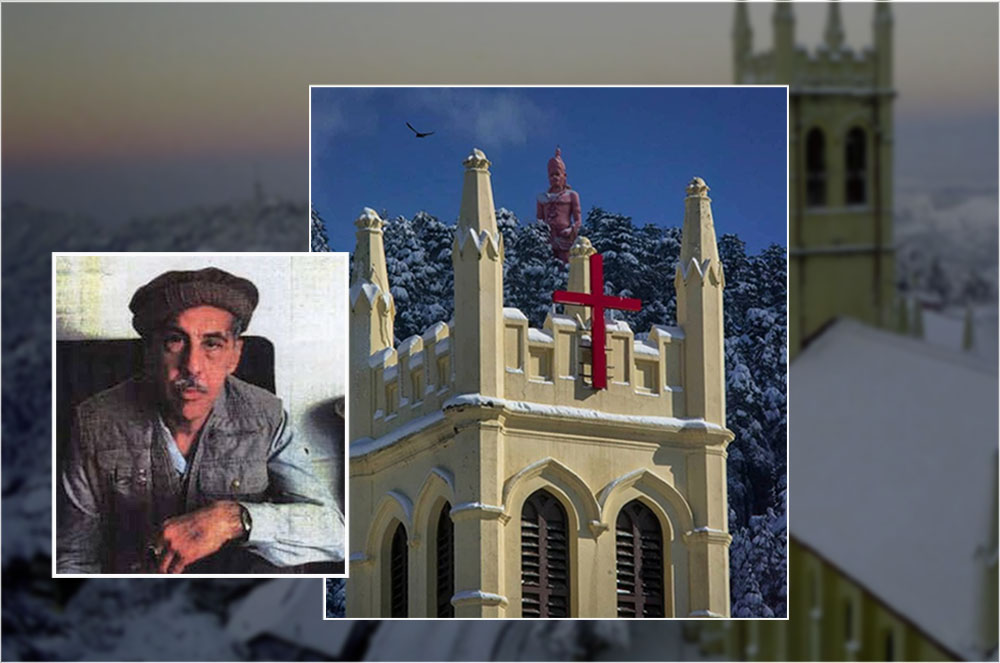
Idries Shah: Remembering the Shimla Born Sufi Thinker

By- Stuti Beri, Educator and Independent Researcher based in Bhilwara, Rajasthan
South Asia has been a land where cultures met, religions interacted and thrived while retaining their own identity, and yet making allowance for a spiritual merging leaving no trace of difference prevailing in the physical space or within the domain of reason. An example in this context is the Sufi Movement which invariably spread the message of love being the only means of seeking the divine. One of the greatest seekers, thinkers and teachers who spread the Sufi tradition outside this land was Idries Shah. Though he spent all his life in the United Kingdom, but he was born in South Asia on 16 June 1924, in a small Western Himalayan town of Shimla (the then Summer Capital of British India and currently part of Himachal Pradesh, India), to an Afghan-Indian father and a Scottish mother.
“Deep in the sea are riches beyond compare. But if you seek safety, it is on the shore.” – Idries Shah
Abandoning the shore, his early year travels with his father, Ikbal Ali Shah (An author and diplomat who penned the biographies of Kemal Atatürk and the Aga Khan III) engaged in his Sufi work, gave him exposure to prominent intellectuals and statesmen from the east and west, and greatly affected his sensibilities as a young child allowing him such opportunities of intellectual gain which aided him in becoming a man possessing a highly broadened vision of the world, and a luminary who unveiled the mysticism associated with Sufism and laid bare its practical approaches to life.
He authored over three dozen books ranging within a wide spectrum of spirituality, psychology, travelogues, and cultural studies. “Shah devoted his life to collecting, translating and adapting key works of Sufi classical literature for the needs of the West. Called by some as ‘practical philosophy’, – these works represent centuries of Sufi and Islamic thought aimed at developing human potential to its fullest form.”
Idries Shah’s initial works dealt with minority belief systems based on magic and occult. But one of his significant work ‘The Sufis’ published in 1964 came as a breakthrough wherein he gave Sufi mysticism a more assessable and readable form appealing to the Western intellectuals and brought to forefront the world of Sufi mysticism. He presented Sufism as constantly changing and adaptable to different modes of life, and each time taking a new form to suit different people, at different times, in different ages, thus giving Sufism a Universal position. He wrote that, “The Sufi doctrine is known in the West as a scientific method of inductive proceeding, and subsequent Western science is largely based upon it.”
Shah gave the spiritual wisdom of Sufism being more of a psychological treatment making it a scientific instrument assisting an individual in achieving self-realization, a way of human evolution, i.e., development of our conscious towards the higher realms of life. In the preface to his book ‘The Sufis’ he wrote “Sufism, the “secret tradition,” is not available on the basis of assumptions which belong to another world, the world of intellect.” It deals with connecting to an inner voice, like the one comprising of prophetic, intuitive or telepathic powers functioning beyond the dominion of reason. Further, he talked about the stark difference between scholasticism and Sufism, “Scholasticism is interested in accumulating information and making deductions from it. Sufism is engaged upon developing a line of communication with ultimate knowledge, not with combining individual facts, however historically exciting, or theorizing in any way at all.”
He also worked profusely in bringing the Sufi tradition of storytelling and folklores to the masses, while understanding the way these stories would affect one psychologically. He reincarnated the stories to accommodate his western audience, and one of his most famous and recognized stories till date are centred on a wise fool Mulla Nasrudin. These anecdotal stories full of humour and intricate wisdom also became a part of his documentary Dreamwalkers aired on BBC in1970. In Shah’s study circle people use to read, analyze, and uncover the hidden layers of meanings these stories contained. Yet these stories proved apt for people of all ages imparting the right kind of wisdom at the right time. Revealing newer perspectives these stories became a tool to churn ones consciousness and provide a new lens to view life.
Idries Shah’s works gained for him universal readership and recognition from many literary writers and his pupils like Ted Hughes, J.D. Salinger, Doris Lessing, and an endless list of admirers coming from different professions. His books were translated in many languages and were read world over.
Idries Shah’s effort weren’t limited to propagating the Sufi thought through his writings, rather he established a notable institute for charity education, Institute of Cultural Research (London), to support scholarly talks and debates on various aspects of human behaviour, culture and Sufi tradition, which later transformed into The Idries Shah Foundation. Meanwhile he also started the Society for Sufi Studies and in 1960 developed his Octagon Press to publish and distribute translated Sufi classics and his own works.
All his life he produced books with a feverish devotion towards Sufi wisdom and lived the life of a true Sufi going beyond the pain and limitation of the physical body, which his later age ailments caused him. Leaving his magnum opus for enlightening the generation to come he left his worldly abode on 23rd November, 1996 for his passage beyond the clutches of corporal life.
Doris Lessing writes about him in his The Daily Telegraph obituary, “He was a many-sided man, knowing a great deal about a variety of subjects, and that meant that listening to him was an education in more ways than one. He was the wittiest person I expect ever to meet. He was kind. He was generous.”
Staying away from the guru or cult system Idries Shah, a Sufi thinker, teacher and writer, unfurled to the world a treasure chest of Sufi Wisdom inspiring many a prominent personalities and common readers across the globe. Just like he believed, his books are a legacy he left for the spiritual seekers, scholars, readers, Sufi practitioners and for any commoner, who is searching for sanity in chaos, and is aiming at communicating with one’s truer self or knowing a deeper meaning of life while being surrounded with a sense of lifelessness. His works eco his brilliance and make it equally viable for any individual to get drenched in that brilliance and get answers to the questions arising in his quest ridden soul.
“What you seek is seeking you.” says Rumi the great Sufi mystic and poet. So for anyone seeking the path of Sufism while living and facing the struggles of everyday life, absorbing the light emitting from the works of Idries Shah would act as a pivotal point in his journey, not for knowledge but for wisdom, not to live life but to know it, to experience a sense of completeness, a universality within, to go on his voyage to encounter the all promising, encompassing, maddening, unconditional and mystic love essential to seek and connect with the divine within.
“The union of the mind and intuition which brings about illumination, and the development which the Sufis seek, is based upon love.” – Idries Shah
Disclaimer: The opinions expressed in this article are those of the authors. They do not purport to reflect the opinions or views of the Himachal Watcher or its members.





Shimla, April 25, 2025 – The Swarn Samaj protest at the Shimla Secretariat on April 24, 2025, led by Rumit Thakur of the Dev Bhumi Kshatriya Sangathan, has drawn sharp criticism for its insensitivity and disregard for public safety. The group demanded that the Himachal Pradesh government retract a notification promoting inter-caste marriages through financial incentives, a policy aimed at reducing caste-based discrimination.
However, their road blockade caused a massive traffic jam, trapping school children in cabs and buses, and they showed no empathy by continuing the protest despite the recent Pahalgam terror attack that killed 26 people.
The Swarn Samaj’s opposition to the inter-caste marriage policy reflects resistance to social equality, prioritising caste traditions over justice. This stance undermines India’s constitutional values of fraternity and equality. Worse, their protest disrupted public life by blocking roads, leaving school children stranded and scared. Videos showed children crying amid slogan-shouting.
Disregard for National Grief
The timing of the protest, just two days after the April 22 Pahalgam attack, was particularly deplorable. While the nation mourned, with groups like the All India Muslim Personal Law Board pausing their protests in solidarity, the Swarn Samaj ignored the collective grief, revealing a lack of compassion. Their history of disruptive protests, including a violent 2022 demonstration that injured five police officers, underscores a pattern of entitlement and disregard for the law.
The Himachal Pradesh government must hold the protesters accountable for endangering children and disrupting public life. The Swarn Samaj’s actions—endangering children and ignoring a national tragedy—show a shameful lack of empathy. India needs unity and compassion, not divisive protests that harm the vulnerable and undermine progress.
Unfortunately, the Chief Minister, Sukhvinder Singh, seems to have yielded to these protestors too.
Disclaimer – Opinions expressed in this article are strictly personal.
Opinion
A young leader’s activism combined with the concept of ‘Himachaliyat’ and ‘Virbhadra Singh Vikas Model’ may be a gamechanger for the Congress in Himachal

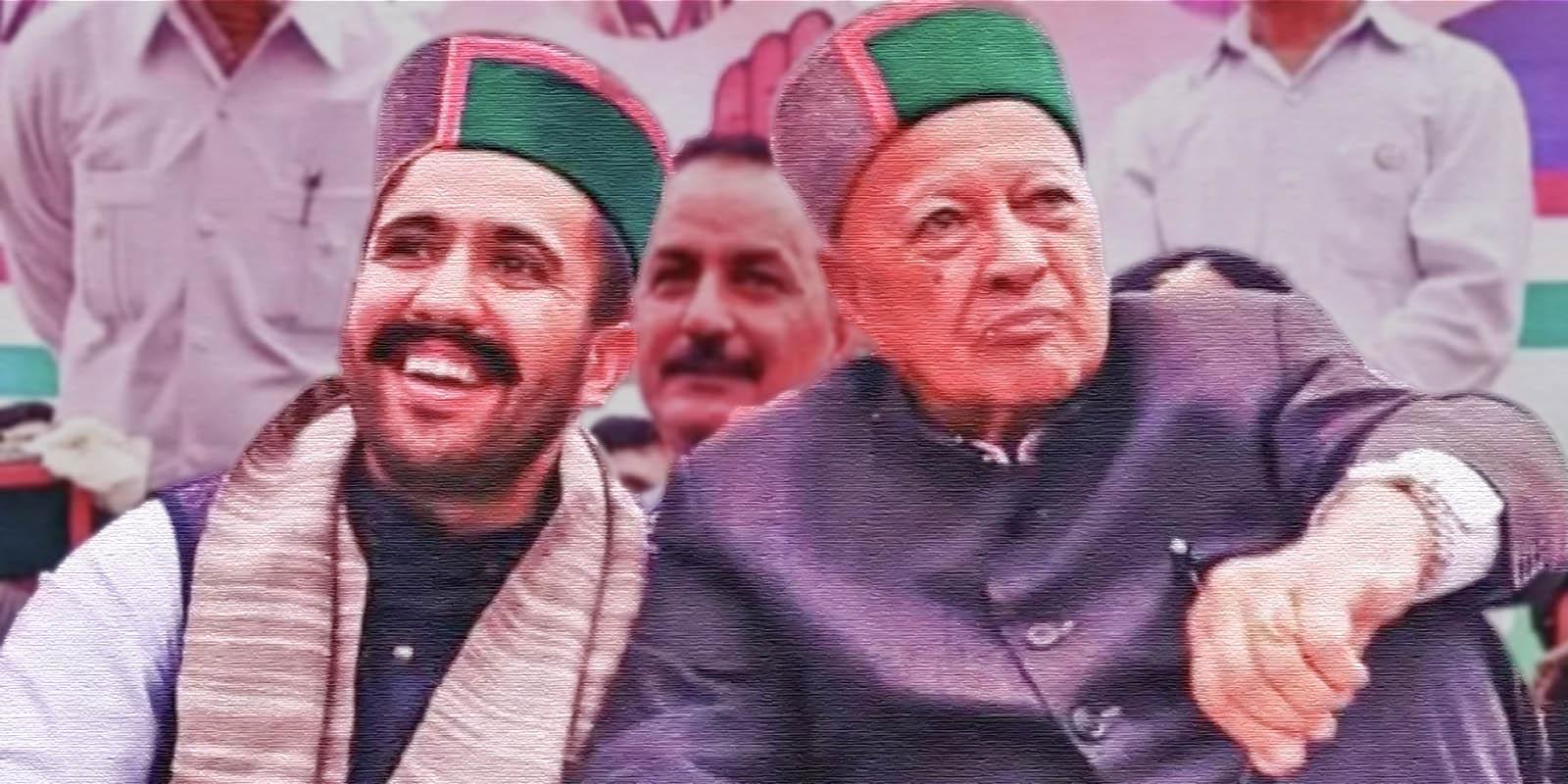
By – Vishal Sharma, who is a researcher and consultant with an LL.M. in Legal & Political Aspects of International Affairs from Cardiff University, United Kingdom.
Full disclosure: He is currently a Research Coordinator with the Himachal Pradesh Congress Committee and has worked as a consultant aligned with the All India Congress Committee in the recent Uttar Pradesh assembly elections handling field operations in mainly Bareilly, Rae Bareli, and Varanasi districts.
Building on the legacy of his father the late Virbhadra Singh, Vikramaditya Singh’s electoral campaign for the assembly elections may deliver an unexpected gift to the Congress in this western Himalayan state.
As political parties in India battle it out for the upcoming 2024 general elections, observers of Himachal Pradesh may spot some interesting -trends in this western Himalayan state. Leaders of national parties may even learn a thing or two if they can look beyond their centralized tunnel visions.
The ruling BJP has had remarkable victories in numerous state elections like Uttar Pradesh, Uttarakhand, Goa, and Manipur. Many political pundits have upheld these results as the final nail in the coffin of the Congress.
But in Himachal, it’s a different story.
Going by inputs from party workers and reporters on the ground, BJP’s momentum might break in Himachal. And, contrary to general perceptions and to the surprise of even many Indian National Congress leaders, the Congress is actually doing well here.
There are multiple factors behind this development, including the BJP government’s poor performance in the state, especially its poor handling of the Covid crisis.
The efforts of numerous state leaders have also contributed towards this upward trajectory. What stands out in this context is the electoral campaign being run by Vikramaditya Singh, a 32-year old member of the legislative assembly from the Shimla (Rural) constituency.
He is the only son of late Virbhadra Singh who passed away in 2021, one of Himachal’s most iconic political figures. A six-time chief minister of Himachal Pradesh, nine-time member of the state’s legislative assembly, and five-time member of the Indian Parliament, he remains unmatched in political stature, popularity, and acceptance.
It’s a tough act to follow. Which is perhaps why Vikramaditya, a career politician, and Virbhadra Singh’s only son, can’t afford to rest on his father’s laurels. He chose to jump into the fray on his own steam and cut his political teeth as a youth activist before being elected president of the Himachal Pradesh Youth Congress in 2013.
The elder Singh, whose political activity began tapering off in 2017, had consistently upheld certain values throughout his political career spanning six decades. His values and achievements, repackaged in catchy terminology, are not only keeping his legacy alive, but are fuelling his son’s campaign.
Former Deputy Advocate General of Himachal Pradesh Tarun Pathak believes that “Vikramaditya Singh is slowly and steadily emerging as the pan-Himachal leader which the Congress party desperately needs”.
“Vikramaditya’s style of taking on the BJP leadership in the state also reminds older activists of his father” says Devinder Bushahri, Spokesperson of the Himachal Pradesh Congress Committee.
Many believe that this together with his youth, social media prowess, and a solid campaign are making him a potential gamechanger in the upcoming electoral battle.
BJP’s momentum runs into the Himachaliyat Wall
The first weapon in Vikramaditya Singh’s arsenal is his narrative of ‘Himachaliyat’ – a term he coined based on his father’s pluralistic regional ideology.
‘Himachaliyat’ encapsulates the idea that the region and its people will decide their future without outside interference.
It also exemplifies a diverse, harmonious culture evident in local festivals, language dialects, cuisines, and clothing.
He is fiercely protective of this centuries-old indigenous tradition of inclusivity and syncretism in this hilly homeland of Himachal.
This also serves as a counter to the hegemonic narrative of caste and religion that is the hallmark of the ruling BJP. He often refers to how the BJP-led government and the Sangh Parivar, Saffron family, of hyper-nationalist organisations, have tried to erode Himachaliyat.
“Himachal’s election will be fought on regional issues, it will be fought on the issue of Himachaliyat. We will not tolerate elements who try to divide us on sub-regional, caste-based and religious lines for political gains,” says Vikramaditya.
He fiercely opposed the BJP-led state government’s attempt in 2018 to amend Section 118 of the Land and Tenancy Act, 1972 that restricts outsiders from buying agricultural land in Himachal Pradesh. He also fought the proposal to change the name of Shimla to Shyamala.
His efforts contributed to public awareness on these issues. Both proposals were shot down.
View this post on Instagram
Vikramaditya Singh’s Instagram reel on Himachaliyat has garnered over 101K views since 23rd July 2022
‘Virbhadra Singh Vikas Model’ over ‘Delhi Model’
The second prong in Singh’s campaign arsenal is what he calls the Virbhadra Singh Vikas Model, highlighting and promising to take forward the numerous developmental works of his late father.
“This terminology is gaining popularity and is proving to be a strong counter to the AAP and its Delhi model,” comments Devender Sharma, a political scientist and former research associate at the Indian Institute of Advanced Studies (IIAS), Shimla.
Many leaders from the Aam Aadmi Party’s state unit in Himachal have left the party including its former state president. The AAP had tried to replicate in Himachal how they governed Delhi, touting the AAP’s transformation of the capital’s education sector.
“Virbhadra Singh ensured that education reaches to every corner of the state, a difficult task given the state’s tough terrain and tricky geographical location, thus comparing the developmental works in hilly Himachal with the Delhi plains in uncalled for,” says Sushant Keprate, secretary, Himachal Pradesh Congress Committee
Scoffing at their efforts, Vikramaditya Singh highlights the numerous developmental works undertaken during Virbhadra Singh’s tenure.
Actual work on the ground over decades takes Vikramaditya’s narrative beyond rhetoric. During Virbhadra Singh’s 2012-17 chief ministership, more than 42 new government degree colleges were opened, raising the number of such institutes to 119 at the time. The face of primary education in Himachal Pradesh was also transformed in Singh’s tenures, under which most of the policies were framed, from the 1980s to the 2000s. Nobel Laureate Amartya Sen and Jean Dreze acknowledge this in their book Uncertain Glory: India and Its Contradictions (Princeton University Press, 2013).
“Some say we will bring the Delhi model, others say we will bring the Punjab model. But in Himachal only one model has worked and that is the Virbhadra Singh Vikas Model”, says Vikramaditya, promising to adapt and take his father’s legacy forward.
Vikramaditya Singh talking about the“Virbhadra Singh Vikas Model’
Activism over politics
The third weapon in Singh’s arsenal is his appeal to the youth, government employees, and farmers of the state. His rallies focus on addressing their concerns, particularly issues of unemployment and agriculture.
The Congress has recently promised employment to 500,000 youth of the state if it is voted to power. It has also assured farmers and horticulturists that they will play a part in deciding the price of their produce. Leaders like Vikramaditya Singh have played a major part in rolling out such poll promises.
Observers note that Vikramaditya’s on-ground approach supporting the issues of these communities is more like an activist than a politician. This may be why he is the most ‘followed’ opposition leader in Himachal Pradesh on various social media platforms, with over 287K followers on Facebook and close to 55K on Instagram. Many of his speeches broadcast on Facebook live sessions reach thousands.
This also makes him the most targeted opposition leader with the BJP and AAP gunning for him on social media. With no chink in the governance front to exploit, the criticism can only take up the issue of dynastic politics.
“The attacks have not diminished his popularity and he continues to receive massive public support for his rallies and outreach programmes from all sections of society.” says Madan, editor of Himachal Watcher, the state’s oldest online English magazine.
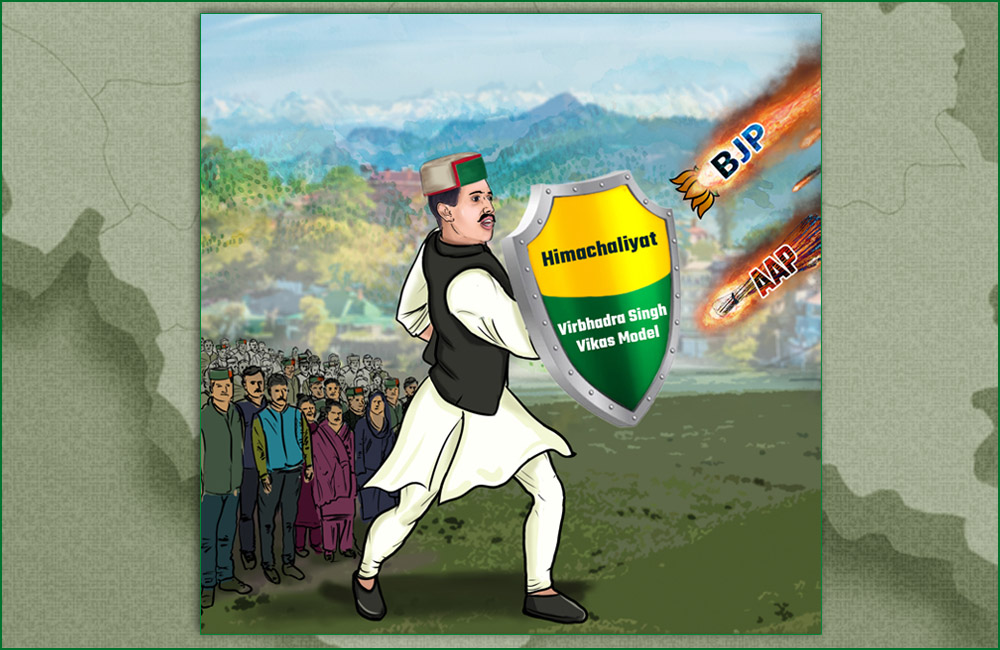
Vikramaditya Singh uses the shield of “Himachaliyat” and “Virbhadra Singh Vikas Model” to counter political rivals. Visual by artist Deepak Saroj in Noida
The way ahead
Observers believe that Vikramaditya Singh’s activism and his narratives of Himachaliyat and the Virbhadra Singh Vikas Model may help the Congress inch ahead of the BJP and AAP in Himachal Pradesh. Many traditional Congress voters who had moved away from the Congress in the last election may return to its fold.
“Vikramaditya Singh needs to be credited for the re-emergence of the INC in Himachal Pradesh as he is one of the few who understands that for insuring victory merely revolving around issues surrounding roti, kapda and makaan (food, cloth and shelter) is not enough and a strong counter-narrative is needed to take on the BJP & Co,” says, Amit Pal Singh, General Secretary, Himachal Pradesh Congress Committee.
Now the question is, will the Congress high command in Delhi look beyond its centrally managed election management machinery and boost this successful approach.
That, only time – and the upcoming polls – will tell.
Disclaimer – Opinions expressed in this article are strictly personal.
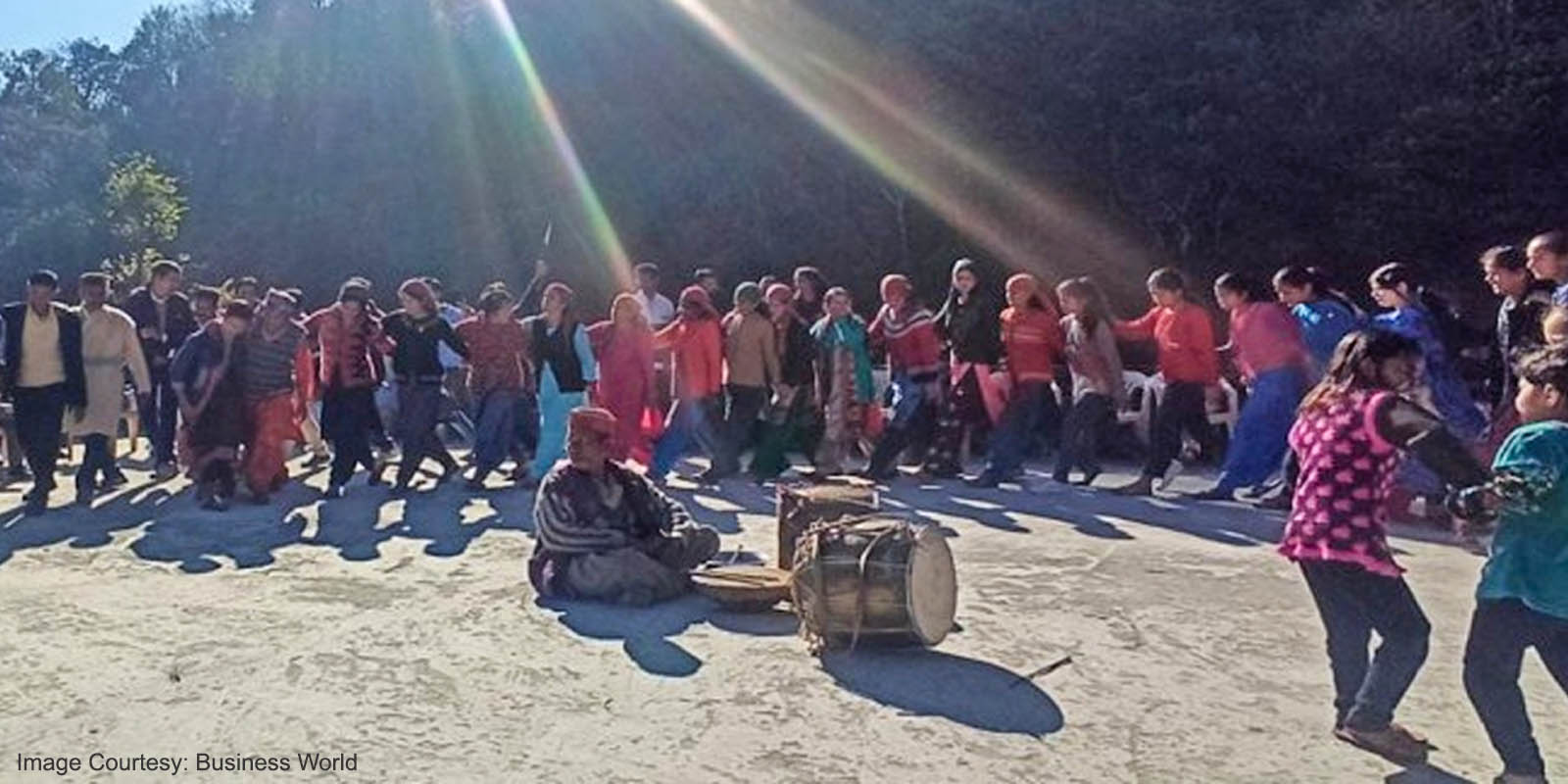
By – Dr. Devender Sharma, Assistant Professor, Department of Political Science, Government Degree College, Chail-Koti, Shimla District (Himachal Pradesh).
The opinion piece deals with the paradox over the demand for Scheduled Tribes (ST) status by the electorally-influential Hatti Community in Sirmaur District of Himachal Pradesh. Different socio-economic and political factors have made this issue complex and as political parties, especially BJP and Congress are doing their best to woe this community for electoral gains. Only time will tell what is in store for the community as a whole and the parties involved.
Hattis have had a long-standing demand for Schedule Tribe status since 1967 when such status was accorded to the people of the community living in Jaunsar Bawar (present-day Uttarakhand), a part of the wider Western Pahari Belt which sshares a similar culture, territorial contiguity and a common border with the Sirmaur district. The 0.35 million strong Hatti community consists of 14 clans and is spread across 154 Panchayats in the Trans-giri region. The community through its Central Hatti Committee succeeded in 2009, when their demand was included by the Bharatiya Janata Party in its manifesto. Hatti leaders have been mobilizing people by holding Khumblis and have continuously put pressure on the government to expedite the matter. Many within the state have supported their cause but the same has been opposed by Scheduled Caste communities and other backward classes making this issue a paradox.
Understanding The Community
The word ‘Hatti’ comes from ‘Haat’ which means a shop. The Hattis are a close-knit community who derive their name from their traditional occupation of selling home-grown crops, vegetables, meat, and wool at small-town markets known as ‘haats’. Back in the days when there were no roads or shops in Sirmaur, people used to carry agricultural produce to the markets in towns like Vikasnagar, Dehradun, Kalsi and Paonta Sahib. The produce would be traded for back salt, oil and spices. The shopkeepers in those towns used to call these people Haati.
The present population of the Hattis is estimated at around 3 lakhs. Hattis are divided into fourteen castes. However, a fairly rigid caste system operates in the community — the Bhat and Khash are considered upper castes, while several castes come under the scheduled castes and other backward classes. Inter-caste marriages within the community are traditionally discouraged. The Hattis are governed by a traditional council called ‘khumbli’ which, like the ‘khaps’ of Haryana, and Western Uttar Pradesh, decide community matters arbitrarily despite the establishment of the Panchayati raj system.
Traditional Elites and Role of Khumbli in Caste Divided Society
In rural Sirmauri society, the traditional elites still have a dominant position in social as well as political spheres. Most of the Lambardars, Zaildars and Pujaris are on the chair of formal establishments and control the informal as well as formal structures simultaneously. The objectivity of these Khumblis is questionable because the decision-making process is controlled by Rajput’s and Brahmin’s due to their ascribed caste supremacy. On the other hand, the Scheduled Castes are denied to play any role in the Khumbli. They are under a state of dominance as their whole socio-economic life is dominated by the village Devta. Any violation of rules framed around the Devta institution turns up the ‘Dev Dosh’ (divine wrath) upon them.
The Devta institution also decides the relations between different castes and assigns them work with some promises among different castes which is known as ‘Akhar Paur’. The functions of the Khumbli are undemocratic and against the egalitarian social order as the Scheduled Castes and women are excluded from the deity institution due to hierarchical social ranking and ritual impurity.
Power structure is dominated by upper castes on the basis of three attributes of dominance viz, ritual status, land holdings and numerical strength. They occupy land holdings which are mostly fertile, whereas the depressed castes have very less land and that too is usually unfertile. The traditional village elites the Lambardaar and the Zaildaar are mostly in possession of the land. Even with the introduction of new democratic institutions, caste panchayats are not losing their significance and caste sentiments continue to be exploited to obtain political power in formal PRI’s.
Present conflict has also had its roots in HP Village Common Land, Vesting and Utilization Act of 1974 by which the Shamlat land given after independence was taken back from the peasants. Under the Reorganization Act 1948, Land Ceiling Act 1972, HP vide Land Estate Evacuation Act 1954, the government procured most of the land from the princely states and big landlords and further from the Shamlat Pool. It was distributed to poor peasants, landless and dalits. In the year 2001, the BJP government made an amendment in the 1974 Act and they were made the owner of that land. Then, in 2017 the government made a law which had provisions concerning taking back the land from new landholders and distributing it to old landholders. The same has triggered the conflict between dominant and dominated caste groups.
Fear of Scheduled Castes and Other Backward Classes
The region is witnessing growing opposition from the scheduled castes and backward communities to the government’s move of granting ST status to the Hatti community. They fear that they would be deprived of their constitutional rights if ST status is given. Recently, Bhim army chief Chandrashekhar Azad Ravan, while addressing a rally in Shimla, said that a grant of ST status would give upper castes the license to further exploit the Dalits. Sirmaur has the highest population of SCs in Himachal Pradesh. According to the 2011 census, Sirmaur has a total population of 5,29, 855, out of which 1,60,745 or 30.34 percent belong to the SC category. In some blocks of Sirmaur like Rajgarh and Sangrah, the dalit population is as high as 45 percent and 40 percent respectively. Atrocities reported against Dalits are also highest in the Trans-giri region.
Besides this they also have the fear that after the declaration of ST status to the Hatti Community they would be losing SC and OBC reservations and they will become an underdog in competition with dominant castes. Dalit activists say that no doubt Sirmaur continues to be one of the poorest and backward areas of Himachal, but what it needs is special financial packages and good developmental plans, not ST status at the cost of SC communities. “To say that only ST status would bring in development here is wrong. So much is already happening in the Trans-giri region in terms of connectivity and facilities including those of health and education. What we require today is a final development push through special packages,” says Ashish Kumar.
Perspective of Hatti Leaders
On the other hand, Haati leaders say, it’s a genuine demand and would benefit all castes and the entire Trans-giri region. “These fears of the SC communities are meaningless and we are doing our best to dispel them,” says Amichand Kamal, the President of the Kendriya Haati Samiti (KHS). “To begin with, SC communities would have an option whether they want to avail reservation benefit as SC or ST like it happens in other scheduled areas,” says Kamal.
The Hatti leaders feel that their development has been stalled due to the absence of tribal status. “If we get the status of a tribe, it will give impetus to the development works in the area, as well as open employment opportunities for the people of our community,” says Amichand Kamal. Further, Ramesh Singta Chief spokesperson of the Shimla unit of the Central Hatti Committee says, “We have been peacefully raising this demand for a long time. But now, the Hatti community has decided that if there is no right to tribal status, then we will not be exercising our right to vote,”
Political Gimmick
Due to BJP’s 2009 Lok Sabha election manifesto promise to give ST status to the Hattis, many members of the community sided with them. In 2014 Rajnath Singh also assured the same to the community in a rally in Nahan, Sirmaur. Then in 2016, the then Congress Chief Minister Virbhadra Singh moved a file to the Union Ministry of Tribal Affairs asking for tribal status to the Trans-giri region, and Dodra Kwar in Rohru on the basis of a study conducted by the Tribal Affairs Institute, Shimla. The Union Ministry, however, said that the ethnography report about the Hatti community was inadequate, and sought a full-fledged ethnographic study. In March 2022, the Jai Ram Thakur government sent a detailed ethnographic proposal to the Centre, seeking the inclusion of the Hattis in the ST list of Himachal Pradesh. But nothing has happened since.
The Way Forward
The demand for ST status for the Hattis has its socio-economic and political nuances making it more complex. Supporters of the demand extend two arguments; one of the Lokur Commission criteria for the establishment of ST status, where they try to establish their geographical and cultural contiguity with the Jaunsar and Bawar region of Uttarakhand which has been given tribal status. But the claim raises conceptual doubts, as the primitive traits among Hattis were not communal as the name of the community itself suggests its character as a surplus-producing community having class stratification.
Secondly, their socio-economic backwardness and their belief that giving tribal status may possibly speed up the development process in the region. Again, this argument also seems puny as almost sixty years of changes have transformed these societies from backward tribal societies to more developed societies with more modern markets and social-political structures. The change must be recognized.
Thus, the issue of the ST status seems more of a political issue in terms of the BJP wanting to strengthen its grip in the area which has largely been a congress bastion.
On the flip side, the present conflict and more specifically the opposition by the scheduled castes and other backward castes of this demand must be seen in terms of the present power structures in the region.
Coming to the bottom line, the solution to the present conflict seems to be based on the idea of an egalitarian and just society which would create a broader unity among the different sections of the Hatti Community. For creating this unity, it is essential to address the issues and the fears of scheduled castes and other backward classes which constitutes around 30 to 34 percent of the region’s population. Thus, alternative schemes of development must be explored for addressing the problem of backwardness and underdevelopment in the region.


Himachal’s LPG Supply Hit Amid Global Tensions, Likely to Affect Hospitality Industry

Himachal Teen Survives 12-Minute Leopard Attack, Kills Predator in Self-Defense

Weather Forecast for Himachal Pradesh For the Next Two Weeks

Monsoon 2025: Himachal Pradesh Suffers 199 Casualties, Over ₹1,905.50 Cr in Damages

 Home Decor Ideas 2020