
Environment
SC’s Forest Diversion Regulation a Blockade on Forest Rights Act Implementation in Himachal: Himdhara

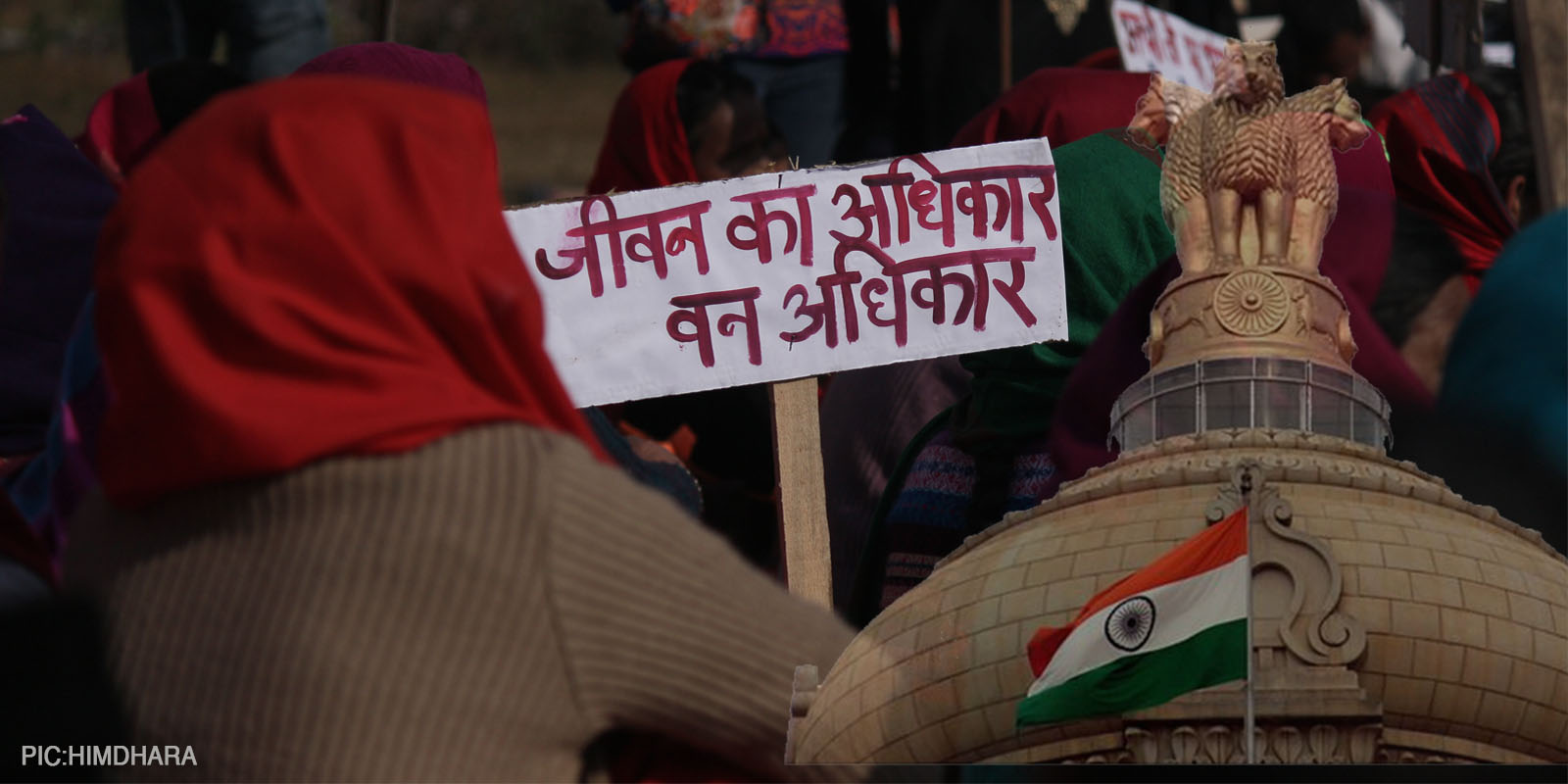
Shimla–Himdhara Collective, a Himachal-based environment research and action group, has released a report on the implications of the regulation imposed by the Supreme Court on forest diversion under the Forest Rights Act 2006 in Himachal, through a series of orders passed last year. This brought to a screeching halt the implementation of Section 3(2) of the FRA which grants powers to gram sabhas and Divisional Forest Officers to divert upto 1 hectare of forest land for 13 types of village welfare activities like roads, schools, community centres, PDS shops etc.
The court orders were based on the conclusions drawn by a Supreme Court Monitoring Committee, headed by a retired PCCF, V.P Mohan, that the diversions were leading to green felling and deforestation in the state. Initially, a stay was imposed on all green felling in the state (in a matter of forest diversions under FCA 1980 and FRA 2006) on 11th March 2019. This stay was partially relaxed but the Supreme court sought all FRA proposals to be brought before it for further diversion.
The report titled ‘Missing the forest for Trees’, assesses the ground reality behind the conclusions drawn by the Supreme Court Monitoring Committee based on which these diversions have been restricted.
“We have found that the Supreme court’s orders need to be reviewed because the alarm raised by the V.P Mohan committee with regard to FRA was a false one”,
stated authors of the report which is based on analysis of RTI information as well as field research.
RTI data sought from the Forest department for all cases under section 3(2) of the Forest Rights Act 2006 from 2014 to 2019 (up to January 2019), was analysed to reveal that 17237 trees were felled in an area of 887.56 hectares for 1959 activities in 41 of the 45 forest divisions of the state.
Roads, followed by schools and community centres dominate the type of activities carried out. Of the total land diverted 91% is for roads. It was found that almost 64% of these diversions showed ‘nil’ trees felled. The average number of trees felled per hectare is very low (19.52) and it may be induced that most activities have been carried out in areas with open forest or no trees.
Rohru (Shimla), Nachan(Mandi), Kinnaur and Chopal were some of the divisions which had a large number of diversions, again mostly for roads.
Case studies we carried out in Mandi and Kangra district showed the desperate need for amenities like village link roads and schools. In Himachal, there remain about 41% villages that have no road connectivity which affects access to health, education and market centres.
On the other hand, large development activities like four lane highways, hydropower projects and transmission lines, have had a much larger ecological footprint in terms of tree loss in the state compared to the very minute, incomparable diversions under FRA.
The report also finds that as far as green cover is concerned in the period corresponding to the high number of forest diversions under FRA (2015-2019), the forest survey of India’s statistics show a 333 sq.km increase in the forest cover.
Why development rights under FRA important for Himachal?
1.No Land available with revenue departments and panchayats for ‘welfare activities’ thus forest land only option
The report concludes that given the fact that 2/3rd of the geographical area of the state is recorded ‘forest area’ where strict forest laws have restricted non-forest use, the FRA provides relief for communities to access basic welfare facilities, which should be seen as their fundamental right and therefore should not be hindered.
2.Cumbersome, costly and lengthy process under FCA 1980
Before FRA it was the Forest Conservation Act, 1980 which governed forest diversion even for small local development activities. This required not only permission from the Central Government (MoEFCC Regional or Delhi Office) but also warranted that user agencies deposit funds (Net Present Value of trees) to carry out Compensatory Afforestation. The whole diversion process under FCA was cumbersome, lengthy and costly, and thus a major hurdle in providing the rural areas, especially remote areas, access to basic welfare development facilities.
“The section 3(2) of the FRA provides relief for both governmental departments and local communities as it overrides the FCA and puts in place a simple and decentralized process for diversion”states the report.
3.FRA is meant to correct the problems that were posed by strict central forest laws
The Forest Rights Act was passed by the parliament of India in 2006 recognising that across the country there are lakhs of communities dependent on land which is legally categorised as ‘forest land’ and are unable to exercise their basic livelihood and development rights due to extremely strict forest laws. Under this act’s Section 3(1), forest-dependent communities can file claims for their individual and community rights exercised before the cut-off date of 13th December 2005.
“As it is Himachal has been sluggish with FRA implementation and only 136 titles have been issued under section 3(1). But atleast the government was proactive with the implementation of section 3(2). With the Supreme court orders regulating this provision, there seems to be an impression amongst the implementing agencies and officials that there is an over-all blockade on FRA in the state”
added members of the collective.
The report has recommended that the state government and nodal agency for the Act – the Central Ministry of Tribal Affairs, put forth the case in favour of section 3(2) of the FRA strongly in front of the Supreme Court and also move swiftly to ensure implementation of all provisions of this law in Himachal.






Environment
Shimla: Retaining Wall Collapses During Four-Lane Construction, Residents Flee Homes to Save Lives


SHIMLA | 3 July 2025 –A major mishap occurred in the Lindi Dhar village of Shimla district during the ongoing four-lane highway construction, raising fresh concerns over safety and construction quality. A retaining wall, constructed as part of the project, collapsed once again—posing a serious threat to nearby homes and destroying hundreds of apple trees.
According to local residents, this is not the first time the wall has caved in. Despite previous incidents, authorities failed to take adequate corrective measures. The latest collapse forced several families to abandon their homes for safety, fearing further landslides and structural damage.
Villagers have accused the National Highways Authority of India (NHAI) and its contractors of negligence. They allege that no proper safety precautions were taken in the construction process, even though the area is known to be vulnerable to landslides.
“This wall had collapsed earlier too, but no permanent solution was provided. Now, we are facing the same threat again. Our lives and properties are at constant risk,” said a local resident.
The landslide also damaged a large number of apple orchards—adding to the losses of local farmers who depend on horticulture for their livelihood.
Residents have demanded immediate intervention from the administration and strict action against those responsible for the substandard construction. They have also urged NHAI to put in place robust safety measures to prevent such incidents in the future.
Local officials have visited the site, and further assessment is awaited.
Environment
Police Complaint Alleges Criminal Negligence in Four-Lane Highway Project Between Parwanoo and Solan

Solan | 30 June 2025 – A police complaint has been filed at the Parwanoo Police Station in Solan district, alleging criminal negligence and environmental damage in the construction of the four-lane highway between Parwanoo and Solan. The complaint, submitted by former Deputy Mayor of Shimla Tikender Singh Panwar, accuses the National Highways Authority of India (NHAI) and its executing contractor, G R Infraprojects Limited, of serious lapses that have endangered lives, property, and the natural ecosystem.
According to the complaint, NHAI officials based at the Chakkar office in Shimla, along with planning teams at Rishikesh Sadan, Shanti Kutia, and the executing agency G R Infra, with its corporate office in Sector 18, Gurugram, failed in their duty to ensure minimal damage to the hilly terrain. It is alleged that the project was undertaken without proper consultation with the Geological Department, resulting in a project report that is “completely erroneous.”
Panwar contends that the design and method of slope cutting are fundamentally flawed, driven by ill-conceived ideas and profit motives.
“Instead of cutting the hills at a slope, the excavation has been done vertically,” the complaint states, warning that this approach poses a permanent threat to residents living near the construction site.
The complaint further highlights that since the beginning of the construction, there have been recurring losses of life and property, which the complainant attributes directly to unsafe and irresponsible construction practices.
Significantly, the complaint raises concerns about possible collusion between NHAI and GR Infra, and urges law enforcement to determine whether the negligence was circumstantial or the result of deliberate wrongdoing.
Panwar has demanded that both NHAI and G R Infraprojects Limited be held criminally liable and subjected to legal proceedings under relevant provisions.
As of now, neither NHAI nor G R Infra has issued an official response.
Environment
Himachal Bans Small PET Bottle, Rs 5,000 Fine on Littering of Single-Use Plastics, Compostable Bags

Shimla, May 27, 2025 – Small PET bottles (up to 500 ml) are littering Himachal Pradesh’s hills, forests, and water bodies, threatening its fragile ecosystem.
Ban on Small PET Bottles
Under the HP Non-Biodegradable Garbage (Control) Act, 1995, the state has banned these bottles in all government-organized indoor meetings, conferences, and events, effective June 1, 2025.
Impact on Hotels
The ban extends to HPTDC and private hotels, which must switch to glass bottles or steel water dispensers. A grace period allows clearing existing stocks to avoid financial losses.
Fines for Littering
A Rs 5,000 fine targets littering of single-use plastics, including compostable bags, by individuals, hotels, restaurants, and other institutions.
Mandatory Car Bins
From April 29, 2025, all taxis and public transport vehicles, including HRTC buses, must install ‘car bins’ for waste collection.
Enforcement Measures
Regional Transport Officers and Motor Vehicle Inspectors will verify bins during vehicle registration. Non-compliance incurs a Rs 10,000 fine, with Rs 1,500 for littering biodegradable waste.
Awareness Campaigns
Government bodies will conduct awareness campaigns to discourage small PET bottle use and promote sustainable practices.
Challenges
Himachal’s ban on small PET bottles and vehicle littering targets plastic pollution but faces challenges. Past bans faltered due to weak enforcement, especially in rural and tourist areas.
Small businesses may struggle with costly alternatives like glass or steel containers. Tourists, a major litter source, need better awareness. The car bin mandate requires rigorous monitoring to ensure compliance. Without robust recycling systems and public cooperation, the ban risks limited impact. Subsidizing eco-friendly options and strengthening enforcement are critical to protect Himachal’s ecosystem effectively.


Himachal’s LPG Supply Hit Amid Global Tensions, Likely to Affect Hospitality Industry

Himachal Teen Survives 12-Minute Leopard Attack, Kills Predator in Self-Defense

Weather Forecast for Himachal Pradesh For the Next Two Weeks

Monsoon 2025: Himachal Pradesh Suffers 199 Casualties, Over ₹1,905.50 Cr in Damages

 Home Decor Ideas 2020