
Environment
Himachal’s Snow Covered Area Has Decreased, Poses Big Threat to State Economy’s Lifelines: Report


Shimla-The area under snow cover in Himachal Pradesh has declined by 18.5% according to a recent report published by State Centre on Climate Change (SCCC) and Space Application Center (ISRO) Ahmedabad. The report revealed this decreasing trend for the five major river basins in the State.
As the report points out, the high altitude regions of Himachal Pradesh receive precipitation mainly in the form of snow during the winter season. One-third of the geographical area of the state is covered by a thick blanket of snow during the winter season. Rivers like Chenab, Beas, Parvati, Baspa, Spiti, Ravi, Sutlej and its tributaries flowing through Himachal are dependent on snowfall in winter. These rivers mainly feed into the Indus water system and a decline at this rate rings a death knell for water and also food security for millions of people from Himachal to Kashmir, the plains of Punjab, the food bowl of the country.
Using images and data received from satellites, the report states, that the winter precipitation was mapped in all the basins from October 2020 to May 2021 (a period of two years). The findings indicate that there has been an average decrease of 8.92 percent in Chenab basin, 18.54 percent in Beas basin, 23.16 percent in Ravi basin, 23.49 percent in Sutlej basin compared to last year. The ice covered area of Chenab basin was 7154.11 sq km in 2019-20, which has come down to 6515.91 sq km in 2020-21. Similarly, Beas basin was reduced from 2457.68 to 2002.03 square kilometer, Ravi basin from 2108.13 square kilometer to 1619.82 square kilometer and Sutlej from 11823.1 square kilometer to 9045 square kilometers. Overall, the snow covered area was reduced from 23542 square kilometer to 19183 square kilometer in the entire Himachal.
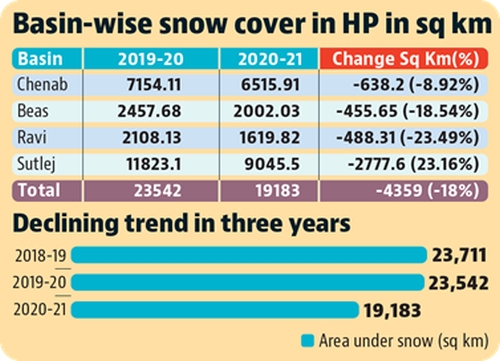
Figure Source: Hindustan Times
Sutlej Basin covers 45 per cent of the total geographical area of Himachal and it is the longest river of the state. It flows for around 320 kms here, passing through Lahaul and Spiti, Kinnaur, Shimla, Kullu, Mandi, Solan and Bilaspur districts, along its course. The above study shows that the maximum reduction in snow cover has occurred in the Sutlej basin. An area of 4359 square kilometers under snow cover has decreased for the whole state, of which more than half of the Sutlej Basin.
Just two years ago another study had indicated that more than half of glaciers in Sutlej Basin are set to vanish by 2050. Yet another study also showed that the Sutlej basin has the highest 562 number of glacial lakes. These lakes stand the risk of sudden outbursts, which then causes flash floods downstream as the valley has already experienced. So, while the crisis that is unfolding, be it deglaciation, lake formation or reduction in area under snow cover, it seems that the Sutlej river basin is more vulnerable to these changes.
Prakash Bhandari, an environmental researcher and activist and member of Himdhara Collective expressing his concern states that the situation in the Sutlej river basin is certainly indicative of a serious climate emergency and it is critical to look into the drivers of this both local and global.
“The Sutlej basin catchment is the largest and so the changes visible here are more significant. Many factors have worked together to create this crisis which should be studied closely. There is no doubt that global warming is contributing to these changes. But the local conditions also play a role in reducing or increasing its impact”, he says.
The upper reaches of the Sutlej Valley, especially areas like Kinnaur are geologically fragile, with sharp gradients and loose soil strata. Vegetation is in a very small area so the proneness to erosion. We have seen the catastrophic impacts of flashfloods and landslides over the last decade and a half, where crores worth of property has been damaged. This year saw a spate of landslides where lives were lost. “In such a sensitive and also strategically important area, changes in the landscape will have far reaching and irreversible impacts. More construction activities will lead to more deforestation, more erosion”.
Construction of dams has been rampant in the Sutlej valley, a phenomena that started post independence and continues today. If all of the planned dams are built the Sutlej will be cho-a-cloc with more then 150, large and small projects. At the bottom of the valley in Bilaspur is the Bhakra Dam, built almost 6 decades ago, which has a size of 168 sq km and a storage capacity of 9.340 cubic km. Is. This is followed by the Kol Dam which extends for 42 km up to Sunni, which has a total storage capacity of 90 million cubic metres. Nathpa Jhakri Project which is 27.394 kms. is long. When a dam is built, a huge amount of water is stored. The debris of many villages, trees etc. also gets absorbed inside the dam. When water is stagnant, it receives heat from the Sun to form mist in the surrounding area by evaporation and simultaneously generates methane gas. The experience of the lake formed by the Kol dam at Tattapani in Mandi district shows that the area is experiencing heavy haze which was not there earlier.
“In the 30s and 40s, Shikari Devi and Kamrunag used to have snow on the peaks for about 6 months, which now could barely stop for only 2 months. The air route distance of Shikari Devi and Kamrunag is only 26 to 30 kms from Tattapani lake. At the same time, their distance is not much from the cement factories of Darlaghat, Sundernagar”, the elders in the area say. “Today, fog is prevalent and this has also made the area warmer”.
Due to the warming of the weather due to the clouds formed from the mist, the snow has started melting quickly. Apart from this the local crop patterns are affected. Post the 1990s, the Sutlej became a site for run of the river hydroelectric projects using extensive underground tunneling. This involves massive use of explosives for blasting through the mountains. Of the 23,000 MW worth of projects to be constructed in Himachal more than 10,000, a third are from this valley alone. Kinnaur continues to be a hydel powerhouse with 10 run of the river projects in progress and 30 more to be set up including two mega projects of 1500 MW and 1000 MW each. This paints a scary picture.
Interactive Sutlej River-Basin Map indicate Hydropower Station location
It is not just the hydro-electric dams but unplanned tourism and other development activities like mining, cement plants, road expansion and mindless construction across the high Himalayan regions have also add to the shift in local weather patterns, land use changes and thus the ecological crisis. But the reason why we should put the limelight on hydropower is that this is being pushed as “Green Energy”, in the name of climate change mitigation. As opposed to other forms of generating power, hydropower projects are said to cause lesser carbon emissions, which is why there has been a global push to shift to renewable resources. But the climate emergency in the Himalayas has put a question mark on ‘water’ as a renewable resource.
The question then arises that with all this data indicating a steady decline in river discharge and snow cover have our planners and policy makers not considered what will happen to these projects? Will they be able to generate the power they propose to? The people of Himalaya have to wake up to this wastage of public resources. Scarce funds should be diverted to better planning for securing local livelihoods by protecting the forest ecosystems and water sources for the future.
Author: Gagandeep Singh-From Himdhara (Environment Research and Action Collective)
Feature Images: unsplash/@raimondklavins






Environment
Shimla: Retaining Wall Collapses During Four-Lane Construction, Residents Flee Homes to Save Lives


SHIMLA | 3 July 2025 –A major mishap occurred in the Lindi Dhar village of Shimla district during the ongoing four-lane highway construction, raising fresh concerns over safety and construction quality. A retaining wall, constructed as part of the project, collapsed once again—posing a serious threat to nearby homes and destroying hundreds of apple trees.
According to local residents, this is not the first time the wall has caved in. Despite previous incidents, authorities failed to take adequate corrective measures. The latest collapse forced several families to abandon their homes for safety, fearing further landslides and structural damage.
Villagers have accused the National Highways Authority of India (NHAI) and its contractors of negligence. They allege that no proper safety precautions were taken in the construction process, even though the area is known to be vulnerable to landslides.
“This wall had collapsed earlier too, but no permanent solution was provided. Now, we are facing the same threat again. Our lives and properties are at constant risk,” said a local resident.
The landslide also damaged a large number of apple orchards—adding to the losses of local farmers who depend on horticulture for their livelihood.
Residents have demanded immediate intervention from the administration and strict action against those responsible for the substandard construction. They have also urged NHAI to put in place robust safety measures to prevent such incidents in the future.
Local officials have visited the site, and further assessment is awaited.
Environment
Police Complaint Alleges Criminal Negligence in Four-Lane Highway Project Between Parwanoo and Solan

Solan | 30 June 2025 – A police complaint has been filed at the Parwanoo Police Station in Solan district, alleging criminal negligence and environmental damage in the construction of the four-lane highway between Parwanoo and Solan. The complaint, submitted by former Deputy Mayor of Shimla Tikender Singh Panwar, accuses the National Highways Authority of India (NHAI) and its executing contractor, G R Infraprojects Limited, of serious lapses that have endangered lives, property, and the natural ecosystem.
According to the complaint, NHAI officials based at the Chakkar office in Shimla, along with planning teams at Rishikesh Sadan, Shanti Kutia, and the executing agency G R Infra, with its corporate office in Sector 18, Gurugram, failed in their duty to ensure minimal damage to the hilly terrain. It is alleged that the project was undertaken without proper consultation with the Geological Department, resulting in a project report that is “completely erroneous.”
Panwar contends that the design and method of slope cutting are fundamentally flawed, driven by ill-conceived ideas and profit motives.
“Instead of cutting the hills at a slope, the excavation has been done vertically,” the complaint states, warning that this approach poses a permanent threat to residents living near the construction site.
The complaint further highlights that since the beginning of the construction, there have been recurring losses of life and property, which the complainant attributes directly to unsafe and irresponsible construction practices.
Significantly, the complaint raises concerns about possible collusion between NHAI and GR Infra, and urges law enforcement to determine whether the negligence was circumstantial or the result of deliberate wrongdoing.
Panwar has demanded that both NHAI and G R Infraprojects Limited be held criminally liable and subjected to legal proceedings under relevant provisions.
As of now, neither NHAI nor G R Infra has issued an official response.
Environment
Himachal Bans Small PET Bottle, Rs 5,000 Fine on Littering of Single-Use Plastics, Compostable Bags

Shimla, May 27, 2025 – Small PET bottles (up to 500 ml) are littering Himachal Pradesh’s hills, forests, and water bodies, threatening its fragile ecosystem.
Ban on Small PET Bottles
Under the HP Non-Biodegradable Garbage (Control) Act, 1995, the state has banned these bottles in all government-organized indoor meetings, conferences, and events, effective June 1, 2025.
Impact on Hotels
The ban extends to HPTDC and private hotels, which must switch to glass bottles or steel water dispensers. A grace period allows clearing existing stocks to avoid financial losses.
Fines for Littering
A Rs 5,000 fine targets littering of single-use plastics, including compostable bags, by individuals, hotels, restaurants, and other institutions.
Mandatory Car Bins
From April 29, 2025, all taxis and public transport vehicles, including HRTC buses, must install ‘car bins’ for waste collection.
Enforcement Measures
Regional Transport Officers and Motor Vehicle Inspectors will verify bins during vehicle registration. Non-compliance incurs a Rs 10,000 fine, with Rs 1,500 for littering biodegradable waste.
Awareness Campaigns
Government bodies will conduct awareness campaigns to discourage small PET bottle use and promote sustainable practices.
Challenges
Himachal’s ban on small PET bottles and vehicle littering targets plastic pollution but faces challenges. Past bans faltered due to weak enforcement, especially in rural and tourist areas.
Small businesses may struggle with costly alternatives like glass or steel containers. Tourists, a major litter source, need better awareness. The car bin mandate requires rigorous monitoring to ensure compliance. Without robust recycling systems and public cooperation, the ban risks limited impact. Subsidizing eco-friendly options and strengthening enforcement are critical to protect Himachal’s ecosystem effectively.


Himachal’s LPG Supply Hit Amid Global Tensions, Likely to Affect Hospitality Industry

Himachal Teen Survives 12-Minute Leopard Attack, Kills Predator in Self-Defense

Weather Forecast for Himachal Pradesh For the Next Two Weeks

Monsoon 2025: Himachal Pradesh Suffers 199 Casualties, Over ₹1,905.50 Cr in Damages

 Home Decor Ideas 2020