
Environment
‘Dried and Dusted’, Rivers of Himachal seek rescue : Report

Himdhara Environment Research and Action Collective compiled an extensive report titled “ State of the Rivers Report- Himachal Pradesh 2016” on the state of all five rivers and dire need to provide them protection from ecological destruction being carried out in the name of blind development.
Shimla: How much do you know about the rivers that owe their origin to Himalayan glaciers? How much do you know about the river basins in Himachal Pradesh?
A person with an average level general knowledge can tell that the state has five major river basins Satluj, Ravi, Beas, Chenab, and Yamuna.
The Giri and Tons are Yamuna’s tributaries originating in Himachal, which form a part of the Ganga river basin flowing westward.
The other four rivers are major tributaries of the eastward flowing Indus River – one of the longest in world (2000 miles or 3200 kilometres) with a flow twice the size of the Nile.
The Indus becomes a much larger river once it is joined by what is known as the ‘Punjab’ (literally meaning 5 rivers – Satluj, Ravi, Beas, Chenab, and Jhelum).
But how much we know what is happening to these rivers as they are now dammed, stressed out, tampered with and tunneled due to human activity or development. We have not cared about the rivers while harnessing it as a resource for our developmental activities.
These rivers are in a desperate need of rescue from clutches of ignorant humans. They need protection from a human activity known as “development”. Development is inevitable but we can make it more sustainable.
Along with fragmentation of the habitats, the diversion of the river flow to facilitate the hydropower projects, illegal and unscientific sand mining in excess, industrial pollution, unregulated construction etc. create a huge impact on the other life-forms that depend on these rivers, rare and endangered plants, and the livelihood of the local communities.
Himdhara Environment Research and Action Collective has compiled an extensive report titled “ State of the Rivers Report- Himachal Pradesh 2016” on the state of all five rivers and dire need to provide them protection from ecological destruction being carried out in the name of blind development.
The organization said it is a preliminary document for the India Rivers Week. It provides some basic information on Himachal’s rivers and the threats they face.
The report has assessed that the surrounding ecology and livelihood of a local population is today most threatened by 41 big hydro and dam projects and 91 small and micro HEPs.
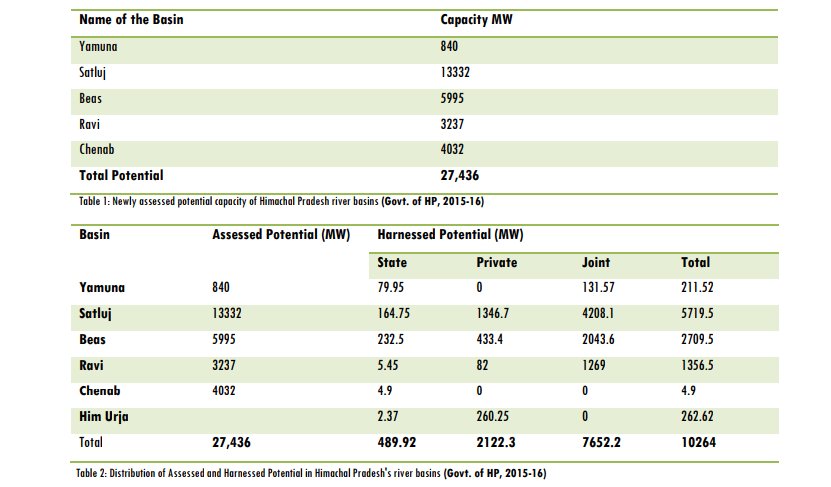
: Distribution of Assessed and Harnessed Potential in Himachal Pradesh’s river basins (Govt. of HP, 2015-16)
As per the report of the Cumulative Impacts (Indian Council of Forestry Research and Education, 2015), in case of Himachal a total of 11665.346 ha have been diverted for different development activities after 1980. Out of it, 62% of the forest land has been diverted for construction of hydro electric projects and transmission lines.
Satluj basin has highest hydropower potential at 13,332 MW.
Already 9 large hydro projects are in operational stage with a total installed capacity of 5780 MW, which is more than 50% of total hydropower generation of the state.
The biggest hydropower projects of the country after Bhakra was the i.e. Nathpa Jhakri 1500 MW in the public sector and Karcham Wangtoo 1000 MW in the private sector built by Jaypee group which also constructed Baspa II of 300 MW.
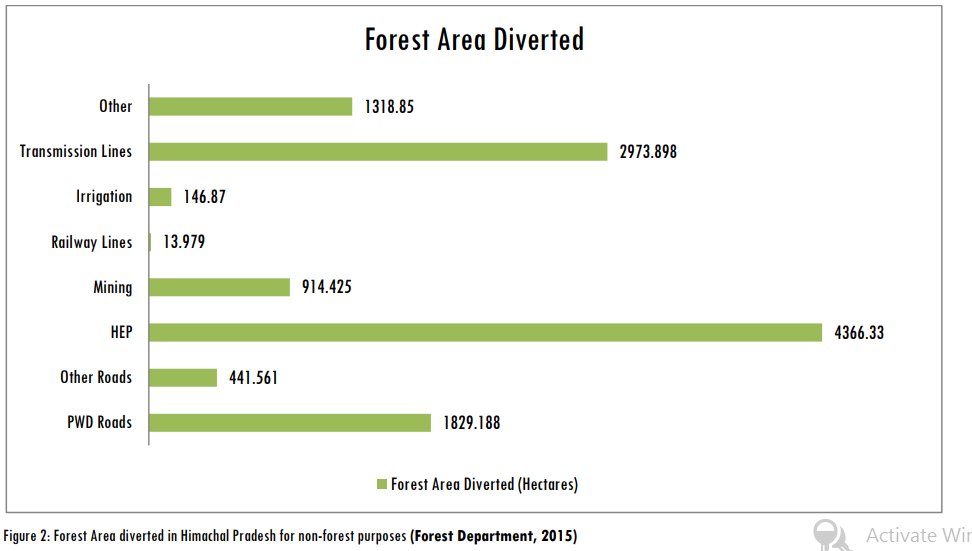
Forest Area diverted in Himachal Pradesh for non-forest purposes (Forest Department, 2015)
So from Karchham onwards the river has been reduced to a trickle as Satluj is diverted in a 17 km long tunnel. Further downstream is Nathpa Jhakri, followed by the 412 MW Rampur project which was commissioned recently. Next was the 750 MW Luhri dam which is now in the doldrums following local opposition. After this comes the 800 MW Kol Dam which located in Bilaspur district Kol Dam has an installed capacity of 800 MW and got commissioned in 2015.
Next was the 750 MW Luhri dam which is now in the doldrums following local opposition. After this comes the 800 MW Kol Dam, located in Bilaspur district. Kol Dam has an installed capacity of 800 MW and got commissioned in 2015.
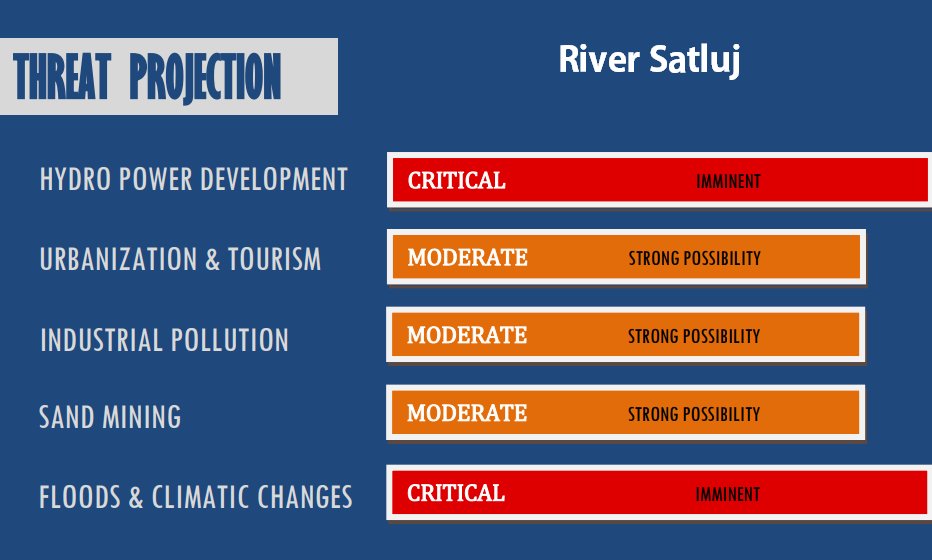
Threat projection for river Satluj
The number of lakes in the Satluj basin rose from a mere 38 in 1994 to 390 in 2014 due to glacial melting, says a 2014 report of the HP State Centre on Climate Change, State Council for Science Technology & Environment. The lakes poses potential threat of flashfloods.
Although the number of lakes has remained stagnant during the last two years, this region has some of the biggest lakes. There are 10 lakes with areas more than 10 hectares and 45 with an area between five to 10 hectares, the report said.

Threat projection for river Ravi
According to the report, the Beas, Satluj, Yamuna and Ravi are the most threatened river basins.
Based on its report, Himdhara has urged the government to design an effective River Protection Plan. Chenab and Spiti should be allowed to flow freely like Tirthan.
In this report we have focused on highlighting the key information about Himachal’s rivers, pointing out the threats that these rivers are facing. We compare the health of these rivers based on the extent of threat that they face,
said Himdhara activist.
The identified key threats include developments which are interfering with river flows, hampering riverine ecology and changing the nature of the river and dependencies around it, said the report.
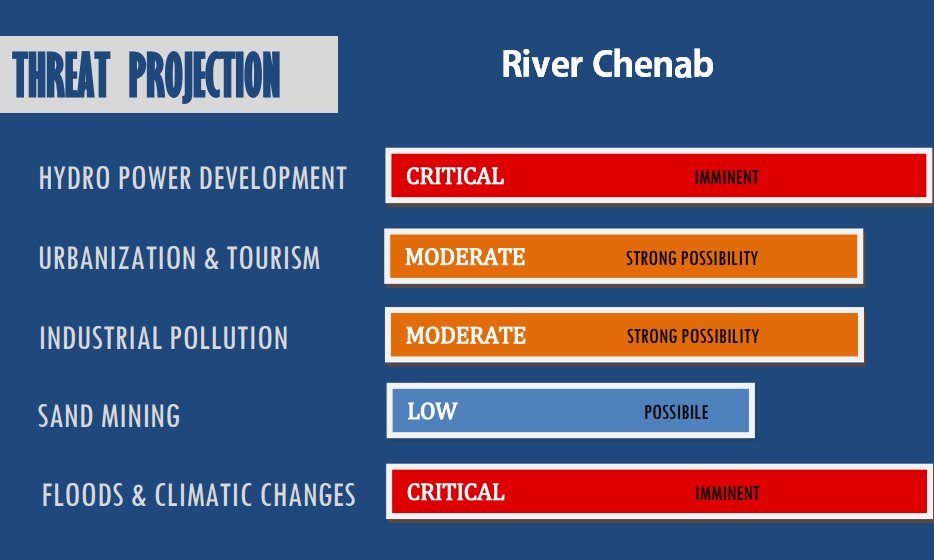
Threat projection for river Chenab
These include hydropower development, Sand Mining, Pollution due to tourism, urbanisation, industrialisation and climatic changes.
We have studied each of these developments for the five river basins and made a threat projection – Critical, moderate or low,
said a Himdhara activist.
The Chenab as of now and Upper Satluj, with Spiti as the main tributary along with parts of Beas, like the Tirthan are the only wild and free-flowing rivers in the State.
There are streams and rivers in small stretches that are pristine but small hydro projects are have been planned around most of them.
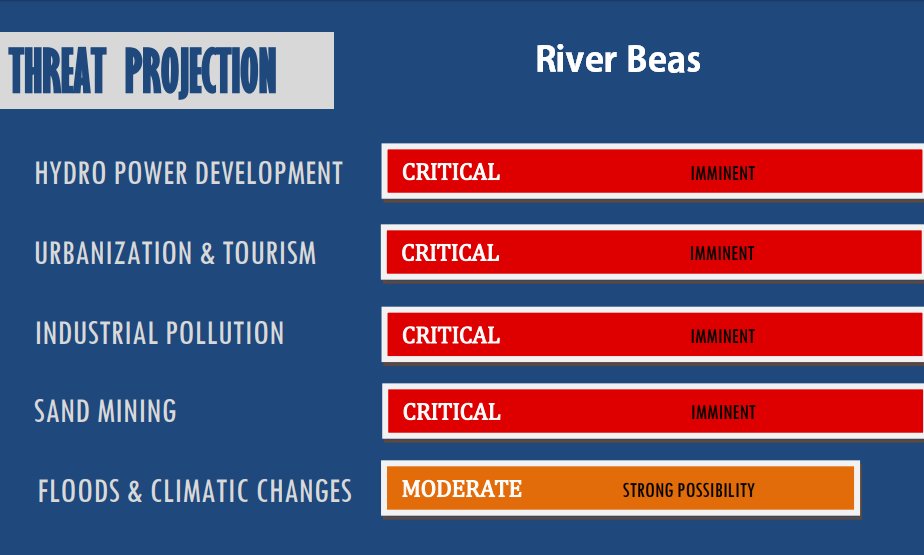
Threat projection for river Beas
Parts of the Tons and Giri tributaries, known for their Mahaseer fish, are under threat due to the dams.
The report recommends that the blue or wild rivers need to be protected from the threats and a plan of action needs to be prepared and executed for the same.
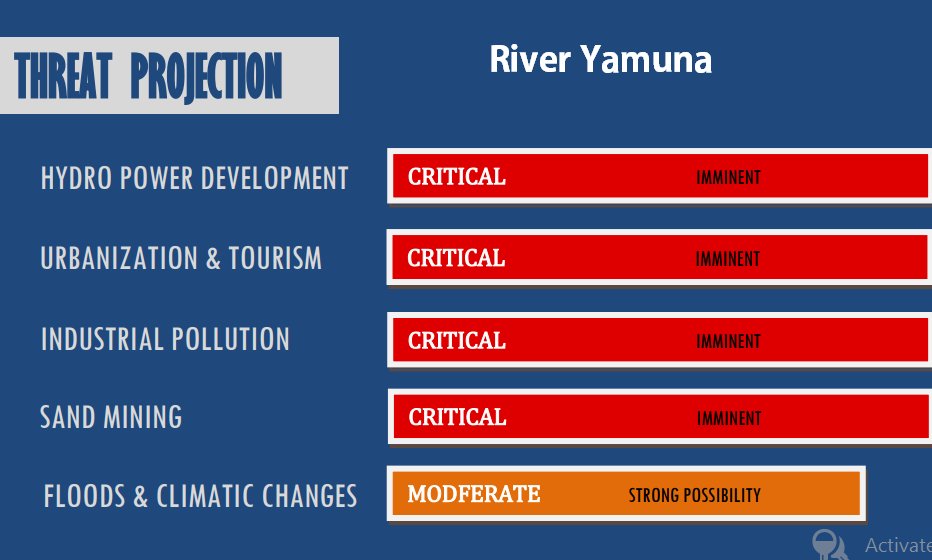
Threat projection for river Yamuna
At the same time, the areas where there is a moderate threat, extensive efforts are required from the regulatory agencies – the Forest Department, Pollution Control Board and the State Environment Department.
A thorough ‘State of the Rivers Report’ should assess the social, cultural, economic values of these rivers and how they have changed historically, carrying out a detailed study based on primary data as well as secondary research from a variety of sources,
said Himdhara activist.
Moreover, it is the communities which depend on these rivers, therefore, they could best describe the changes that have occurred over time. Any assessment would be incomplete without a people’s voice in it.
Most textbooks and articles largely highlight the magnitude of the Himalayan river systems and move on to speak about it anthropocentrically like the energy generation and irrigation potential, to harness them as a source to pursue the never-ending process of development.
People rarely see them as riverine ecosystems that are already providing services and supporting the living beings.
Himdhara expects the report to generate interest and a debate amongst communities as well as policymakers and researchers about the urgency to protect the Himalayan rivers.
Today, we speak of interlinking these rivers but fail to see the existing natural inter-linkages not just between the rivers but also among all life forms, the benefits of which are being drawn by humans.
The Himalayan rivers are older than or as young as the Himalayas themselves. And yet, despite being so powerful and revered, all the life they support, these rivers are vulnerable.
This vulnerability is rarely spoken of. The slightest variation and changes in temperature, flow, course, and composition of the rivers impact their surroundings.





Environment
Shimla: Retaining Wall Collapses During Four-Lane Construction, Residents Flee Homes to Save Lives


SHIMLA | 3 July 2025 –A major mishap occurred in the Lindi Dhar village of Shimla district during the ongoing four-lane highway construction, raising fresh concerns over safety and construction quality. A retaining wall, constructed as part of the project, collapsed once again—posing a serious threat to nearby homes and destroying hundreds of apple trees.
According to local residents, this is not the first time the wall has caved in. Despite previous incidents, authorities failed to take adequate corrective measures. The latest collapse forced several families to abandon their homes for safety, fearing further landslides and structural damage.
Villagers have accused the National Highways Authority of India (NHAI) and its contractors of negligence. They allege that no proper safety precautions were taken in the construction process, even though the area is known to be vulnerable to landslides.
“This wall had collapsed earlier too, but no permanent solution was provided. Now, we are facing the same threat again. Our lives and properties are at constant risk,” said a local resident.
The landslide also damaged a large number of apple orchards—adding to the losses of local farmers who depend on horticulture for their livelihood.
Residents have demanded immediate intervention from the administration and strict action against those responsible for the substandard construction. They have also urged NHAI to put in place robust safety measures to prevent such incidents in the future.
Local officials have visited the site, and further assessment is awaited.
Environment
Police Complaint Alleges Criminal Negligence in Four-Lane Highway Project Between Parwanoo and Solan

Solan | 30 June 2025 – A police complaint has been filed at the Parwanoo Police Station in Solan district, alleging criminal negligence and environmental damage in the construction of the four-lane highway between Parwanoo and Solan. The complaint, submitted by former Deputy Mayor of Shimla Tikender Singh Panwar, accuses the National Highways Authority of India (NHAI) and its executing contractor, G R Infraprojects Limited, of serious lapses that have endangered lives, property, and the natural ecosystem.
According to the complaint, NHAI officials based at the Chakkar office in Shimla, along with planning teams at Rishikesh Sadan, Shanti Kutia, and the executing agency G R Infra, with its corporate office in Sector 18, Gurugram, failed in their duty to ensure minimal damage to the hilly terrain. It is alleged that the project was undertaken without proper consultation with the Geological Department, resulting in a project report that is “completely erroneous.”
Panwar contends that the design and method of slope cutting are fundamentally flawed, driven by ill-conceived ideas and profit motives.
“Instead of cutting the hills at a slope, the excavation has been done vertically,” the complaint states, warning that this approach poses a permanent threat to residents living near the construction site.
The complaint further highlights that since the beginning of the construction, there have been recurring losses of life and property, which the complainant attributes directly to unsafe and irresponsible construction practices.
Significantly, the complaint raises concerns about possible collusion between NHAI and GR Infra, and urges law enforcement to determine whether the negligence was circumstantial or the result of deliberate wrongdoing.
Panwar has demanded that both NHAI and G R Infraprojects Limited be held criminally liable and subjected to legal proceedings under relevant provisions.
As of now, neither NHAI nor G R Infra has issued an official response.
Environment
Himachal Bans Small PET Bottle, Rs 5,000 Fine on Littering of Single-Use Plastics, Compostable Bags


Shimla, May 27, 2025 – Small PET bottles (up to 500 ml) are littering Himachal Pradesh’s hills, forests, and water bodies, threatening its fragile ecosystem.
Ban on Small PET Bottles
Under the HP Non-Biodegradable Garbage (Control) Act, 1995, the state has banned these bottles in all government-organized indoor meetings, conferences, and events, effective June 1, 2025.
Impact on Hotels
The ban extends to HPTDC and private hotels, which must switch to glass bottles or steel water dispensers. A grace period allows clearing existing stocks to avoid financial losses.
Fines for Littering
A Rs 5,000 fine targets littering of single-use plastics, including compostable bags, by individuals, hotels, restaurants, and other institutions.
Mandatory Car Bins
From April 29, 2025, all taxis and public transport vehicles, including HRTC buses, must install ‘car bins’ for waste collection.
Enforcement Measures
Regional Transport Officers and Motor Vehicle Inspectors will verify bins during vehicle registration. Non-compliance incurs a Rs 10,000 fine, with Rs 1,500 for littering biodegradable waste.
Awareness Campaigns
Government bodies will conduct awareness campaigns to discourage small PET bottle use and promote sustainable practices.
Challenges
Himachal’s ban on small PET bottles and vehicle littering targets plastic pollution but faces challenges. Past bans faltered due to weak enforcement, especially in rural and tourist areas.
Small businesses may struggle with costly alternatives like glass or steel containers. Tourists, a major litter source, need better awareness. The car bin mandate requires rigorous monitoring to ensure compliance. Without robust recycling systems and public cooperation, the ban risks limited impact. Subsidizing eco-friendly options and strengthening enforcement are critical to protect Himachal’s ecosystem effectively.


Himachal’s LPG Supply Hit Amid Global Tensions, Likely to Affect Hospitality Industry

Himachal Teen Survives 12-Minute Leopard Attack, Kills Predator in Self-Defense

Weather Forecast for Himachal Pradesh For the Next Two Weeks

Monsoon 2025: Himachal Pradesh Suffers 199 Casualties, Over ₹1,905.50 Cr in Damages

 Home Decor Ideas 2020